Most associations have a tech stack.
However, far fewer have a tech strategy.
At first glance, those might sound like the same thing. In reality, they are not.
And that gap is usually where problems start.
A Tech Stack Is What You Have
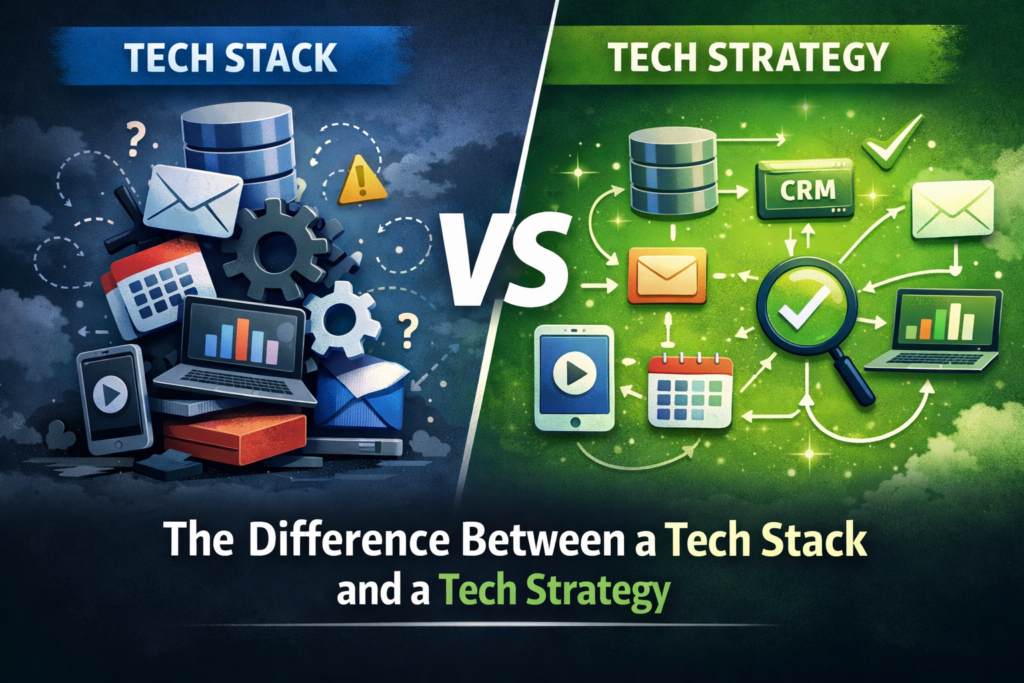
Your tech stack is the collection of systems you use every day.
For example, that includes your AMS, your CRM, your event platform, your email tool, and your learning management system.
Over time, that stack grows. As new needs come up, teams add new tools. At the same time, older systems stick around because they still serve a purpose.
Eventually, you end up with a mix of platforms that all do something important.
That is your stack.
A Tech Strategy Is How It All Works Together
A tech strategy is not about the tools themselves.
Instead, it focuses on how those tools connect, how data moves between them, and how your team actually uses them.
It answers key questions like:
- Where does our source of truth live?
- How does data move between systems?
- What should be automated versus manual?
- How do we support future growth with what we have today?
Without clear answers, even the best tools will fall short.
Why This Difference Matters
You can have a strong stack and still struggle.
In fact, we see this all the time.
Organizations invest in good platforms, but they do not define how those platforms should work together. Because of that, teams create workarounds, data becomes inconsistent, and reporting gets harder.
So, the issue is not the tools.
It is the lack of alignment between them.
More Tools Do Not Equal a Better Strategy
When something is not working, many teams respond by adding another system.
For instance, one platform promises better reporting. Another promises better engagement. A third promises better automation.
Sometimes those tools help. However, without a strategy behind them, they often add more complexity.
As a result, instead of solving the problem, they simply move it somewhere else.
What a Real Strategy Looks Like
A strong tech strategy focuses on clarity and connection.
For example:
- Systems have clear roles
- Data moves intentionally between platforms
- Integrations support real workflows, not just technical connections
- Teams understand how and where to work
This does not always mean fewer systems.
Instead, it means better alignment between them.
Where to Start
If your tech stack feels harder to manage than it should, start by stepping back.
First, look at how your systems interact today.
Then, identify where data breaks down, where processes rely on manual work, and where your team lacks visibility.
From there, you can define how things should work instead.
Final Thoughts
A tech stack is something you build over time.
On the other hand, a tech strategy is something you choose.
And that choice determines whether your systems support your organization or slow it down.

.png?width=2240&height=1260&name=Untitled%20design%20(44).png)

.png?width=2240&height=1260&name=Untitled%20design%20(36).png)